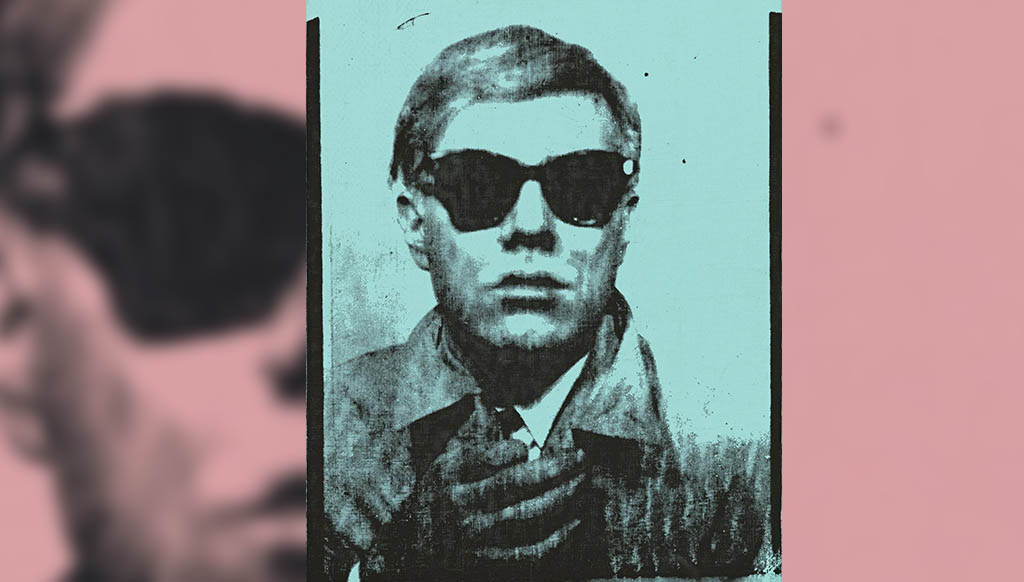
Andy Warhol’s very first self-portrait is being auctioned off by Sotheby’s on June 28 and the estimated price for the portrait has been pegged at about $8 million (£7m). The portrait in acrylic and silkscreen ink on canvas is from the year 1963-64 when Warhol was 35. In the latter part of the twentieth-century, Andy Warhol joined the ranks of Rembrandt van Rijn, Vincent van Gogh, and Pablo Picasso to take his place amongst the most important and influential self-portraitists in the history of art. Throughout his career, he turned to his own visage to create works such as the present painting, filled with immediacy, vivacity, and sleek conceptual cool. This portrait on auction is one of the first ten self-portraits that Warhol ever created. Self-Portrait comes from a concise series of nine similarly titled works, each made in the same scale using silkscreen prints enlarged from the same shred of photographic source material.
Polish automobile tuners Auto-Dynamics, who are famous for their work on Ferrari and Maserati vehicles, have moved their magic wand on a Porsche this time, turning the already awesome 911 Turbo S into the bewitching Dark Knight. Displaying a mysterious matte black exterior, the Dark Night has been treated to an all-carbon ‘Turbo Aerokit’ that includes upgrades such as the new front spoiler, vented fenders, vented hood, side skirts, and a new rear bumper. The rear sports a Stinger GTR rear diffuser along with a Moshammer movable spoiler. The Porsche flat-six engine was reworked to produce 690 horsepower and was given exhaust elements from GMG Racing. The interiors feature a new racing steering wheel and custom RUF floor mats.
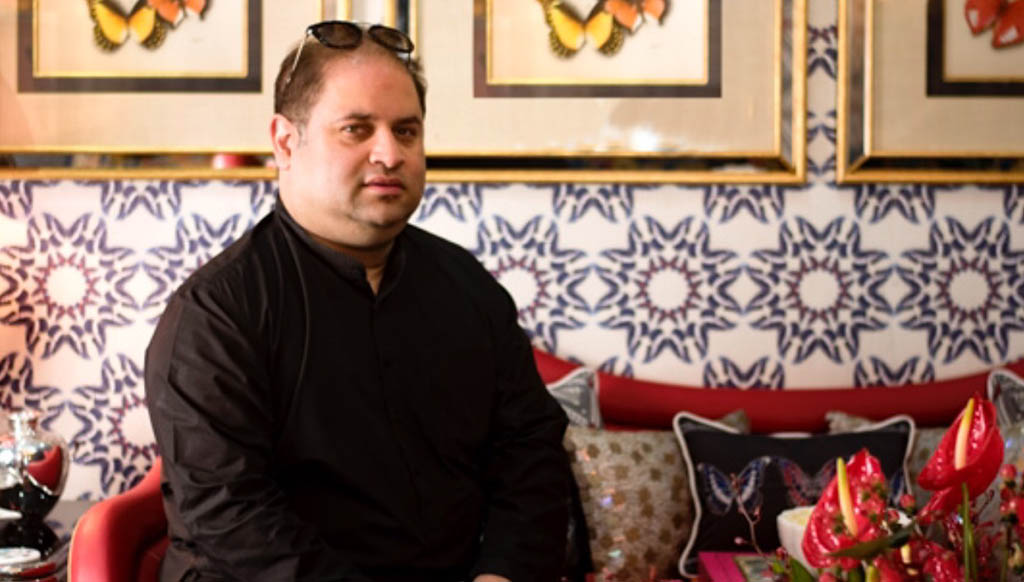
THE PLEASURES OF PLENTY: Adil Ahmad creates what he calls ‘contrived clutter’, playing with surface decoration and giving the space a well-lived look, telling tales of travel
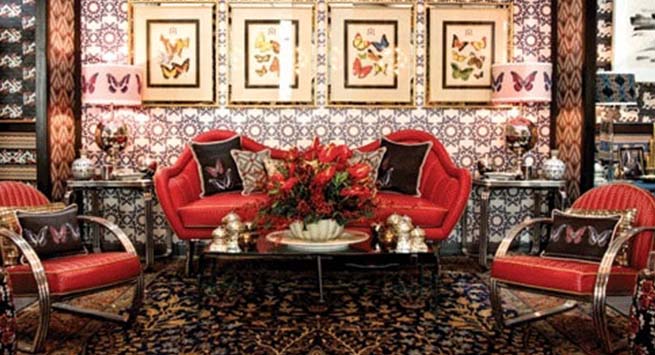
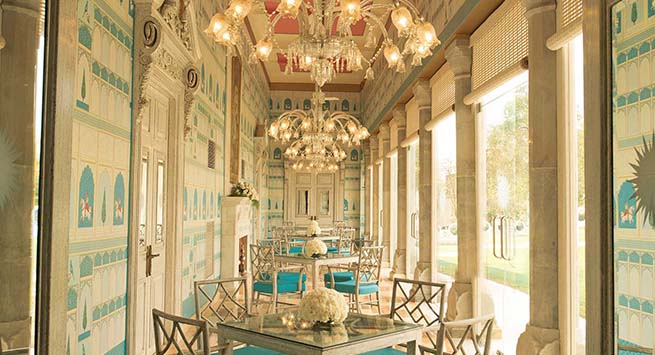
Walking into Adil Ahmad’s Jor Bagh office in New Delhi is a little like stepping into the Robbers Cave from Ali Baba and the Forty Thieves. Treasures unfold before your eyes in a madness of indulgence and you half expect the door to swing open to the sound of ‘Open Sesame!’ Rich red and gold wallpaper lines the walls of the main sitting area; a huge artwork in gold with embossed peacocks adorns the wall on the right, a chest with Chinese engravings sits smack in the center, baithak style sofas flank the room, the table is adorned with gorgeous brick-a-bracks that turn out to be meer-farshes from a bygone era—known as doorstops now, but historically meant to keep the chandni (floor spreads) in place, and even the air-conditioners are painted over in the base colour of the wallpaper. The room is lined with numerous photographs of Adil and his memories, lending an intensely personal touch.
It is, as Adil himself likes to call it, ‘contrived clutter’— mayhem of the meticulous sort.
In the midst of this canvas brimming with vibrance sits Adil Ahmad, founder of The Palace Collection, former Creative Director of Good Earth and interior designer par excellence, in a pristine white Jaipuri cotton kurta, block-printed all over with elephants. His simple sartorial choices speak of the man inside: honest, straightforward with an easy sense of humour and completely down-to-earth—which is especially remarkable given his list of high profile projects that include Vasundhara Raje’s New Delhi home, Saif and Kareena’s wedding reception, and the immensely opulent Sujan Rajmahal hotel. But Adil is also an intensely private man who prefers not to ‘drop names’ or speak of his clients, and absolutely detests having his picture taken. Much as we may love to photograph him amid his treasures, he refuses to be clicked. And he declares himself completely out of fashion, completely out of sync with the trends and competes with no one but ‘himself.’
“My first paid project was in 1993—when I was 16. So I always say now I’m at retirement age”
Perhaps all of this stems from the self-assuredness of the man who quit formal education and dropped out of school at the age of 13—when he was in eighth standard. “I’ve always been aesthetically inclined,” he explains, “When I was young, other children would go to toy stores but I gravitated towards stores with magazines of interiors and literature. I was a big reader and read a lot about historical books from a very young age, and it was a natural progression that grew into what it is today.”
“I never looked at it as a profession. I was in Doon School Dehradun, and I decided in class eight to drop out of school. I used to ask my mother, why am I here? And her reply was that the family has always been there—your father, your grandfather— and I said that’s not a reason for me to be doing it! I hate to do things on a bell! And one fine day I just dropped out. The last I formally went to school was in 1990.”
Even more surprising than the above facts is the revelation that he did his first paid project at the age of 16. “I started working very early,” he says. “My first paid project was in 1993—when I was 16. So I always say now I’m at retirement age! I’ve been working 24 years.” Yes, the sense of humour pervades everything that Adil Ahmad speaks about.
“Now interior designing is the ‘it’ thing to do, it’s a very fashionable profession. Every bored star wife, everyone who has nothing better to do has become an interior decorator!”
But did he have any formal training in interior design? Not in the least. And he’s very vocal about his opposition to such ‘training’, too. “Today everything has become a course or a diploma. Now interior designing is the ‘it’ thing to do, it’s a very fashionable profession. Every bored star wife, everyone who has nothing better to do has become an interior decorator! Back then it wasn’t something people had even heard about. I was aesthetically inclined but didn’t even know there was such a thing as interior design! Luckily we had a large house in Lucknow so I could potter about there and one thing led to another.”
He goes on to narrate an amusing anecdote about the whole question of where he did his ‘training from’: “Some time ago, a fancy university called me to give a talk. They asked me what is the discipline you grew up with, and I said: Nothing— I’m the most indisciplined person, I dropped out of school! They said you’re not supposed to say that! Then they asked where did you train in design from? I said, I don’t believe in training because it curbs creativity. And so after the 3-day seminar they were just happy to be rid of me!”
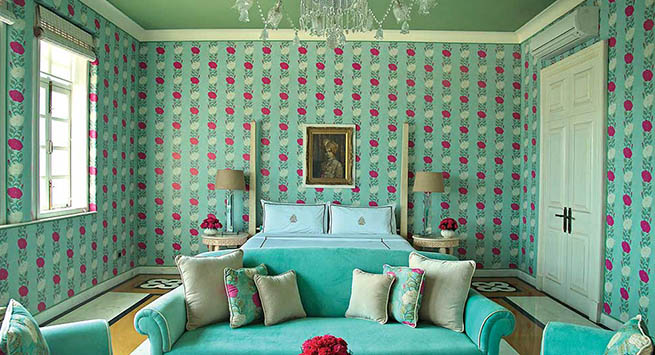
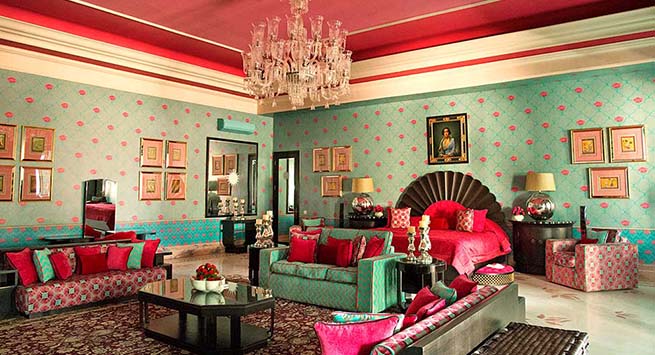
The Kennedy Suite, Sujan Rajmahal palace
This disarming, self-deprecating humour is perhaps just as beautiful as Adil’s designs. He speaks of the reactions of his family— elite, wealthy and Cambridge-educated— who could not imagine such a thing as a drop-out interior decorator son. “My elders used to say: ye to ghaas khodega! (he’ll just be a grass cutter). In the early stages when I used to say I’m an interior designer, my grandafather who loved me a lot, used to tell me beta don’t say all these bekaar ki baatein (utter nonsense). Just say you do nothing. Say you’re from a Raees (elite) family and you don’t need to do anything! Apne ghar ka khaate ho!”
“My elders used to say: ye to ghaas khodega! (he’ll just be a grass cutter)In the early stages when I used to say I’m an interior designer, my grandafather used to tell me beta don’t say all these bekaar ki baatein (utter nonsense). Just say you do nothing. Sayyou’re from a Raees (elite) family and you don’t need to do anything! Apne ghar ka khaate ho!”
But times have changed and how. Accolades and recognition have poured in at Adil’s doorstep. And yet, he doesn’t believe in being trendy or up with the times. In the era of pared-down décor, Adil’s work is a riot of colour, texture and imagination. Does he consciously shun minimalism to swim against the current?
“Minimalism, to our Indian sensibility, is an alien reality,” says he. “We are not Sweden, not Holland. India is all about surface decoration. Starting from Mohenjo Daro to Ajnta Ellora, the Mughal palaces, the Red Fort, the Golden Temple—you name it— all religious places carry surface decoration. So that’s what I carry forward—lots of surface decoration, indigenous handiwork. We have absorbed so many cultures. What is Indian culture? It’s a diaspora of cultures that have come together—Hindus, Muslims, Sikhs, Christians and Parsis and so on. I’m not trying to make something that is royal or chic or posh. It’s just a collection of beautiful things put together.”
“It’s not about expensive things, it’s about a well-lived space which tells that you’ve been on a journey—you’ve travelled.”
He points out each beautiful object adorning the room around him—the trunk from China, the embossed peacocks artwork from Bhutan, a brass plate on the table from Moradabad, marble meer farshes made in Rajasthan. “It’s not about expensive things, it’s about a well-lived space which tells that you’ve been on a journey—you’ve travelled. It’s not that one fine day I’ve gone and bought something from a particular designer in say, England. Sadly, that’s what’s happening today: we walk into homes and they just look like showrooms. There’s no personal touch because sadly today people are not in touch with their own realities. They are just trying to ape another person or what they perceive is ‘it’.”
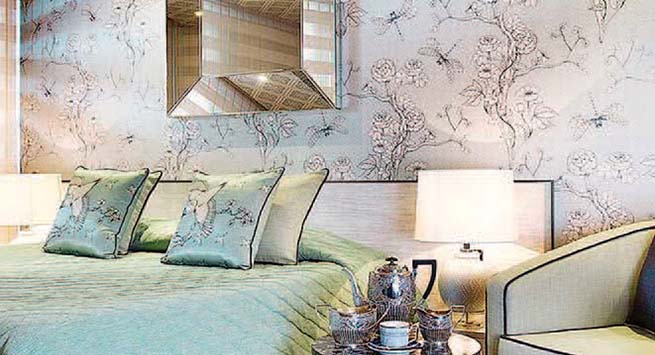
Interiors by Ahmad, Chicago
He tells you that sometimes clients come to him and ask what’s in fashion? “I tell them I don’t know, I’m the least in fashion—look at me!”
The self-deprecating charm comes into play again as he cracks jokes at his own expense. “Look, my kurta is pure cotton, brought from the Dastkar shop in Ranthambhor. It’s cheap, it’s cheerful, it’s cool and suits our Indian climate! I couldn’t stuff myself into Dolce & Gabbana. I mean that’s amazing stuff but I know I would look like a gargoyle in it!” he guffaws.
“Today, we walk into homes and they just look like showrooms. There’s no personal touch because sadly people are not in touch with their own realities.”
But then he turns philosophical. “It’s just a question of being in touch with your reality and being comfortable with yourself. Every day I wake up and I don’t think I’m doing anything lofty—I’m just doing a job—like everyone else. I’m not tripping on my success. There’s no great epiphany I get while sleeping at night! Today there this whole thing of ambition and everyone’s driven by social barometers. How many projects, how many lakh square feet, this client and that project. I’m in it for myself. One shouldn’t take oneself so seriously.”
So does he prefer indigenous arts and crafts, ethnic designs and weaves? “I like contemporary Indian design. My sensibility is grounded in Indian design, but in a contemporary idiom. Design or style cannot remain petrified; it has to move with the times. Mine is an indigenous, contemporary colonial style. When Lutyens created the Rashtrapati Bhawan, he gave the columns to Indian architecture. But the dome was inspired by the Sanchi Stupa and the huge verandahs cater to the Indian climate. So it is a very organic mixture.” He points to the sofa he sits on and continues, “Now this is a European sofa but in a Baithak style. Otherwise sofas were not Indian. You always had the chandni or the carpet where you sat— and these are the meer farshes used to keep the carpet down. When Europeans started using them they became door stoppers. Here they were supposed to keep the sheets from blowing off. Similarly, the shama daans were made to keep the breeze from blowing the candles off. In Europe there were all closed rooms so there was no need for them. Design is constantly evolving, so we don’t need to be purist about it.”
“Mine is an indigenous, contemporary colonial style. When Lutyens created the Rashtrapati Bhawan, he gave the columns to Indian architecture. But the dome was inspired by the Sanchi Stupa and the huge verandahs cater to the Indian climate. So it is a very organic mixture”
But ethnic is not his style, and he’s not making a conscious effort to revive indigenious crafts. “With all due respect, I’m not a revivalist! I’m not Laila Tyabji who revived Indian textiles. I’m nothing so lofty— I just make do with what’s available.”
The Maharani’s Aprtment, Sujan Rajmahal palace
So what are the three most significant things he keeps in mind when designing spaces? “Texture, pattern and symmetry,” he states. “I’m obsessed with symmetry. I’m very much into texture and layers.” His love for symmetry is very evident in his own office space—but is there a particular reason for this penchant? “I don’t know! Maybe it’s because I have such a convoluted life that in some aspect you want clarity of thought, clarity of space! You know when someone gives me a gift I think—oh, I wish they’d given me two! I’d rather not have a gift than have just one!”
But then, his primary design principle is to let the space reflect its inhabitants. “I never want a project to reflect me. I like it to reflect the clients’ personality. I like to coax, cajole, interpret a client’s sensibility—not impose my own.”
And is there a particular décor item that is his favourite? “I collect carpets,” he states, but explains further. “When I design I take something as the centrepiece. For instance, in this room I began with the carpet —it has texture, it has pattern , it has patina, it has a certain age to it—so I designed around it. But in the end, it depends on the unique sensibility of the client—they might have a painting, a textile, a chandelier, or a light. It could be a colour, a sensibility, a place. I’m not hung up on that.”
“I’m obsessed with symmetry. I’m very much into texture and layers.”
But then it’s not just homes that he designs, but heritage and boutique hotels too, like the famed Rajmahal Palace. What’s the design style he follows for a hotel? His answer is typically sassy and straight. “By God’s grace, I haven’t allowed myself to be bastardised by commercialism. I don’t take on big hotels. And if I do take on big hotels, they’re bespoke hotels, so I have the luxury of creating bespoke spaces. Whether it is a home or a hotel, for me they’re the same.
No project is ever too difficult, but he feels that more than the large spaces, it’s the really small ones that are the most challenging. “If you ask me doing up this little office of 900 sq feet was far more challenging than something of 90,000 sq feet. Everyone today talks in terms of lakhs of square feet, but the smaller the project the more challenging it is. It’s just like a miniature—creating everything to the minutest detail.”
“Adil has taken on a heritage hotel in Nepal and a ‘very interesting project’ at a coffee estate in Coorg. “I just finished a heritage hotel in UP, too which was a colonial bungalow. Plus I keep doing homes in and around Delhi.”
“For instance, in this room I wanted space for 8-10 people to sit and so everything had to be calculated. The space between the chair and table is exactly 1 inch. You go 2 inches more you can’t walk out the door! It looks like clutter but there’s always a method to it. There are exactly 12 pictures here, exactly the same angel on all sides, candle placed the same way, coasters placed at exactly the same place! There’s a method to this madness! It’s what I call contrived clutter.”
The Palace Collection, by Ahmad
And all this ‘madness’ would soon be directed to his upcoming projects—but he’s extremely tight-lipped about them. All he will concede is that he’s taken on a heritage hotel in Nepal and a ‘very interesting project’ at a coffee estate in Coorg. “I just finished a heritage hotel in UP, too which was a colonial bungalow. Plus I keep doing homes in and around Delhi.” And that’s all he will say on the subject. But he explains why: “I dislike it terribly when I’m written about vis a vis other people and clients. It trivialises me and my work. Today it’s become fashionable to drop names and I think that you’re not sure of yourself if you’re doing that.”
He doesn’t believe in formal collaborations either, which he refers to as ‘arranged marriages’!
“I was the Creative Director of Good Earth in the past… but these Arranged marriages, you know,” he chuckles. “It was a great journey, Mrs Lal and I are extremely good friends. But I think creativity and commercialism don’t go together. When we parted ways, Good Earth had a different trajectory. They were changing the course from being a bespoke design house to more of a commercially viable store—like a crate and barrel. So that’s where the dichotomy was. I thought it was better to remain individual, and I do not franchise my brand, because I would lose control over it. I’m a very small fry in the larger scheme of things. But I like the freedom— I like to touch and feel my projects.”
“Mrs Lal and I are extremely good friends. But I think creativity and commercialism don’t go together. I thought it was better to remain individual, and not franchise my brand, because I would lose control over it. I’m a very small fry in the larger scheme of things.”
Adil does act as consultant to other brands and designers but in a “very loose, informal” way. “They take me on to design one home, or one collection. I’m working with builders but I don’t do 15 row houses for them. I do one house, what they do with it is their concern. “
But he does work with designers he admires. “I love working with other designers particularly with Viya Home. Vikram Goel does amazing, cutting edge design in metal. Then there’s also Beyond Designs. But it’s not a tight collaboration.” Internationally, the designers he loves are Alberto Pinto, Moroccan designer with his atelier in Paris, who passed away a few years ago. “He did everything from planes to boats to palaces to homes—very unusual work. Then there’s Jacques Garcia, too. They inspire me but their style is unique to their sensibility; I cannot interpret that in Indian idiom.”
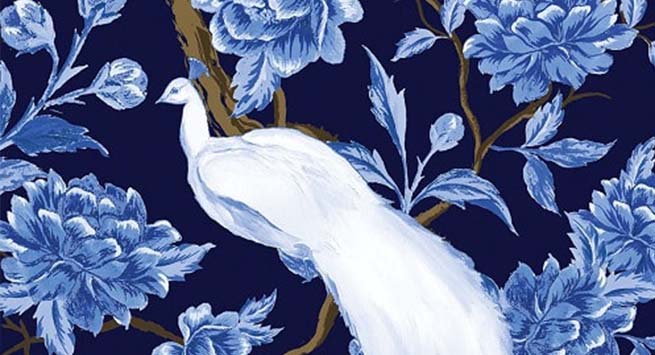
La-Voliere Wallpaper by Adil Ahmad
As far as Indian designers are concerned, he says, “In the Indian sensibility there’s sadly no one I can think of because everyone I see is trying to ape an alien reality. I liked Susanne’s place—she had imported very nice lights, but can I get that whole interior? I can’t. Abu-Sandeep do good work, they use nice products, interesting techniques.”
For now, he’s going off on his two month summer vacation—one of the perks, he says, of owning your freedom. What’s his ideal vacation style? Pat comes the reply: “Being able to not think—to be blank.”
“In the Indian sensibility there’s sadly no designer I can think of (who I admire) because everyone I see is trying to ape an alien reality.”
“For me it’s not the destination, it’s more about the people you’re with and where you’re comfortable. One of my favourite cities in the world is London. I like the pace of life in England, the design, the whole cultural aesthetic.”
But he surprises you by declaring himself a ‘boring person’ who neither drinks, no smokes, nor parties. “I’m not one for nightlife or for the night spots! I’m not a party person, I’m quite a square, boring: I don’t smoke, or drink—or even serve drinks. I don’t fit into the stereotypical image of the designer.”
“I’m not a party person, I’m quite a square, boring: I don’t smoke, or drink—or even serve drinks. I don’t fit into the stereotypical image of the designer.”
“At one interview,” he reminisces “I was asked what is the one thing you never leave home without—and I showed them my tasbih (prayer beads)! They asked me what is your favourite car and I told them I don’t know how to drive! As long as it’s comfortable, it’s air-conditioned, what does it matter?”
So, truly, what does he consider as luxury, then? His answer is most astonishing. “Affordability!” he laughs. “What sways me is affordable luxury—judicious affordable luxury. I don’t buy fabric for more than Rs 600 a metre. I wouldn’t go into a fancy store and buy fabric for Rs 3000 a metre—I don’t wear clothes for that much!” he guffaws again. “I do totally affordable stuff—I’m just glad it gives a luxe look!”
“People just give me all these labels of ‘royal’ and ‘rich’ and all this s**t !” he exclaims. “But have u seen how the royals live, half of them?” He stops short then, and exclaims rather impishly, “God I should be careful what I’m saying!”
“What sways me is affordable luxury. I don’t buy fabric for more than Rs 600 a metre. I wouldn’t go into a fancy store and buy fabric for Rs 3000 a metre—I don’t wear clothes for that much! I do totally affordable stuff—I’m just glad it gives a luxe look!”
On a more serious note, he reiterates, “Why would I want to create China or Versailles or Buckingham Palace in an Indian home? My style is influenced by the homes we grew up in. I grew up in a house designed by an English Architect in the late 30s. My grandfather was India’s first Indian Chief Justice in British times. So it was an amalgamation of the two cultures.”
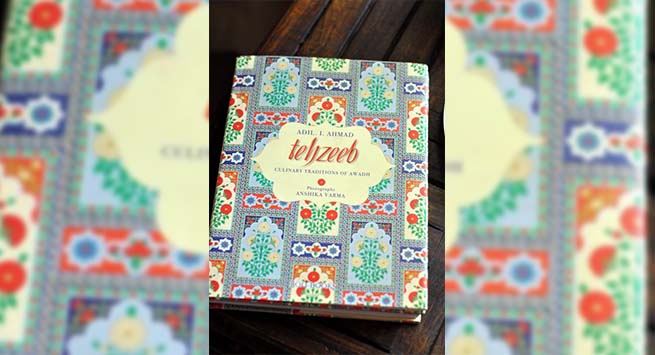
Tehzeeb, Adil Ahmad’s book of special Awadhi recipes and culture
His pride in his heritage is evident from the book he has written on the Culinary Traditions of Awadh, titled Tehzeeb—which he now hands me as a parting gift. Tehzeeb, which means culture (or literally, politeness and sophistication), is steeped in the history of Lucknow, displaying magnificent photographs of not just the dishes whose recipes he describes, but also of his home, his family and history entwined with nuggets of the lifestyle of the opulent in Awadh, and the ornate architecture of the city.
“Today colonial has got bastardised as ‘Raj’ or something foreign. But it is imbibed into the Indian sensibility. I mean who’s to tell what’s Hindu art? Or what is Indian culture? It is an amalgamation of so many diverse streams.”
And suddenly he waxes eloquent on serious social issues like intolerance. “Today we’ve become so intolerant of differences. I think it should be about celebrating differences. Celebrating difference of opinion. See this room—these are kundalini paintings based on Tantric art, the cushion covers are Turkish, these prints from Rajasthan, this is an Iranian carpet from Samarkand. Success is a journey. The day you stop growing or moving is the end. You plateau.”
ROCKS OF COLOR | Pinks and Blues and Oranges rule the roost when it comes to the most jaw-dropping prices fetched by diamonds at an auction
From blue to pink and orange, these huge rocks in unusual colours took everyone’s breath away when they came into the spotlight. Feast your eyes on them and the humongous amounts they fetched at auctions. Beginning with the highest priced, here’s a list of the top five:
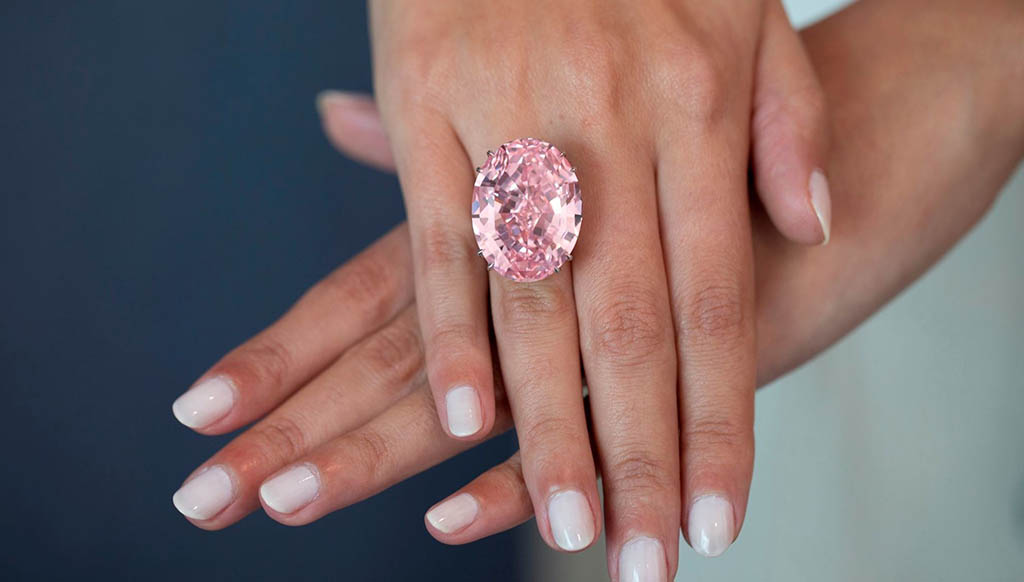
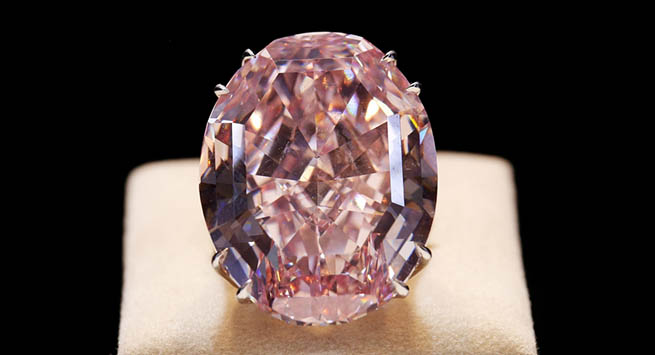
The Pink Star – $71.2 Million
This gigantic 59.60-carat Pink Star diamond went for $83.02 million at Sotheby’s November 2014 auction in Geneva but Isaac Wolf, a New York-based diamond cutter who outbid three rivals for the diamond, actually proved to be unable to pay for it. But it was auctioned off this year at Sotheby’s Hong Kong for $71.2 million. It is the largest Internally Flawless, Fancy Vivid pink diamond ever graded by the GIA.
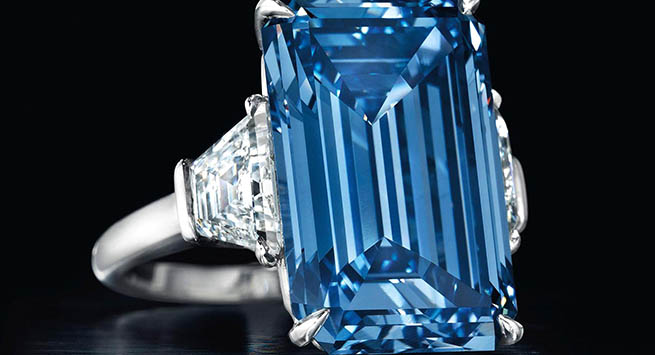
The Oppenheimer Blue -$57.5 million
Before the Pink Star, the Oppenheimer Blue held the record for the highest sum fetched at auction. As the largest Vivid Blue diamond to ever appear at auction, the Oppenheimer Blue diamond fetched a mind blowing $57.5 million in Geneva on May 18, 2016. Named after its previous owner, Sir Philip Oppenheimer—the former chairman of De Beers— this huge 14.62-carat rock claimed an amount well above its asking price of $35 – $45 million. But one look at it, and you’d understand why. A thing of beauty is indeed a joy forever.
The Graff Pink – $46 Million
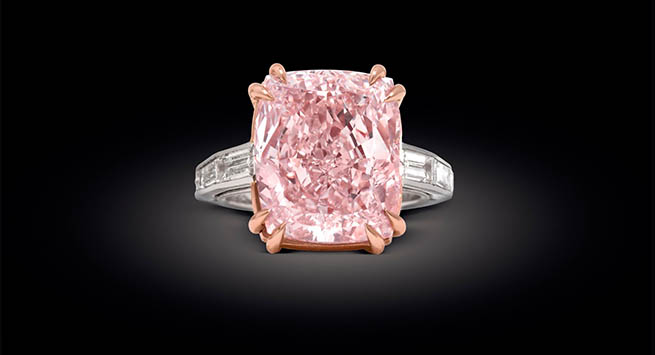
The 24.78-carat, rectangle shaped Graff Pink Diamond is rated ‘fancy intense pink’ and was purchased for $46 million in 2010 by “the King of Bling”, British billionaire Laurence Graff. The diamond was once owned by American celebrity jeweller Harry Winston. Before its sale, the stone was expected to enter the list of the top ten most expensive diamonds in the world; on selling for US $46 million it became the most expensive single jewel ever sold at auction at that time.
The Princie – $40 Million
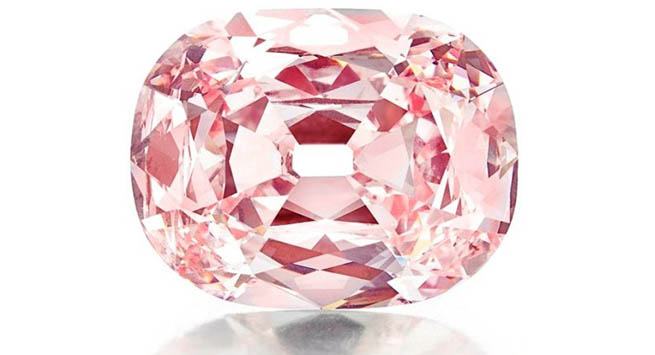
The 34.65-carat pink Princie Diamond is also a fancy intense pink, and what’s more, it is 300 years old, initially discovered from the Golconda mines in India. In 2013, it was sold for $40 million by Christie’s New York. The gem has an interesting history behind it—it has been the cause of a big family feud. In March 2015, Amedeo Angiolillo, an Italian millionaire, sued Christie’s, claiming that his beloved diamond had been stolen by “a backstabbing step-sibling” who had no right to sell the diamond. What actually happened was that the diamond had initially been bought by Angiolillo’s father, Renato, who gave it to his second wife, Maria Girani. Girani held the diamond in her possession until her death. When Angiolillo attempted to repossess the diamond, he discovered that Girani’s son, Marco Biachi Lilella had taken it. According to Christie’s it is the third largest Pink Diamond in the world.
The Orange – $35.5 Million
And now we come to another intense, vibrant colour. The Orange is a 14.82 carat diamond named after its colour and is the largest fancy vivid orange diamond in the world. It was sold in 2013 at Christie Geneva’s Magnificent Jewels sale for $35.5 million. The diamond far surpassed its estimated price of $21 million and broke the world record for price per carat for any coloured diamond sold at auction.
A suit inspired by the Alfa Romeo Giulietta isn’t just a suit—it’s a bespoke, all-weather creation crafted out of luxurious and water resistant Italian wool from British tailors Hawes & Curtis’ 1913 premium collection made in Italy. There’s also a special mesh lining inside the suit which regulates the warmth of the body, adding the finishing touch and making it fit to brave all kinds of weather. The Giulietta’s features are noticeable in the suit, too, such as the honeycomb grille mesh lining. The alloys have been created into a bespoke print for the sleeve lining and the characteristic red highlights along the bumper are reflected in the contrast stitching and red trim on the jacket. According to Hawes &Curtis, ‘the exterior of the high-performance suit stemmed from the Giulietta’s unique DNA driving mode selector, which allows the drivers to seamlessly adapt the car’s driving capability to handle all weather conditions, just like the suit itself.’ Completing the high-end, bespoke look is an array of essential Giulietta accessories. The limited edition ties and pocket squares are made from pure silk and they subtly feature design details found on the Giulietta, such as the pattern of the alloy design. In addition, the lapel pin, cufflinks and tie slide all feature the iconic Alfa Romeo logo.
Jaguar has previewed its E Pace baby crossover ahead of the official global debut next month, 13th July. The E-Pace will get a performance-oriented AWD tech and an all-ingenium line-up of petrol and diesel engines and take on the likes of premium compact crossovers like the Audi Q3 and the BMW X1. The E Pace will soon join the F-Pace which is sold in India and Jaguar’s all-electric I-Pace concept will go into production in 2018.
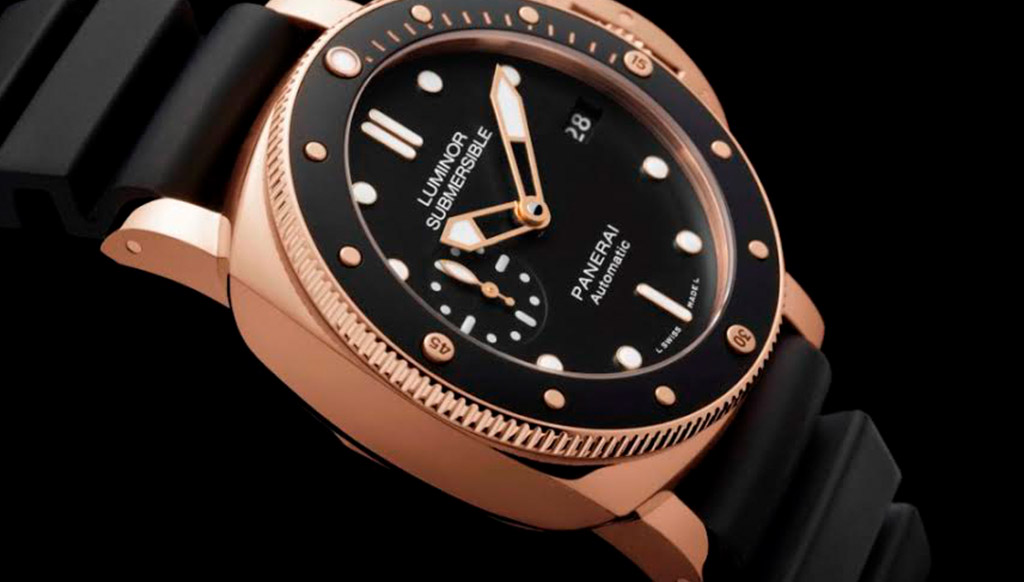
Swiss luxury watchmaker Officine Panerai have unveiled their first ever Submersible watch with the case 42 mm in diameter— the Luminor Submersible 1950 3 Days Automatic. A Divers Professional watch suitable for any situation, the Luminor Submersible 1950 3 Days Automatic is available in two versions: classic, with a stainless steel case (PAM00682), and in red gold (PAM00684), with a black ceramic disk on the rotating bezel, for a sporty look but with a very strong personality. The dial is black with applied luminous hour markers. The steel version (PAM00682) is water-resistant to a depth of 300 metres (30 bar), and the red gold (PAM00684) water-resistant to a depth of 100 metres (10 bar). Both versions have the P.9010 automatic calibre with a power reserve of three days, the time remaining being clearly visible through the sapphire crystal back. They follow the classic Panerai Submersible design, with the Luminor 1950 case fitted with a unidirectional rotating bezel for calculating the time of immersion and the lever device protecting the winding crown. The black dial has applied index markers, the date at 3 o’clock and the small seconds counter at 9 o’clock. At night – or in the darkness underwater – the minute hand and the stud on the bezel at 12 o’clock glow with a bright blue colour rather than the traditional fluorescent green of all the other markers, so that there is always a clear, unmistakable point of reference for calculating the times of immersion. The red gold model’s distinctive element is the matt black ceramic disc on the rotating bezel, with stud markers which, in conjunction with the graduated scale, enable the time of immersion to be calculated.
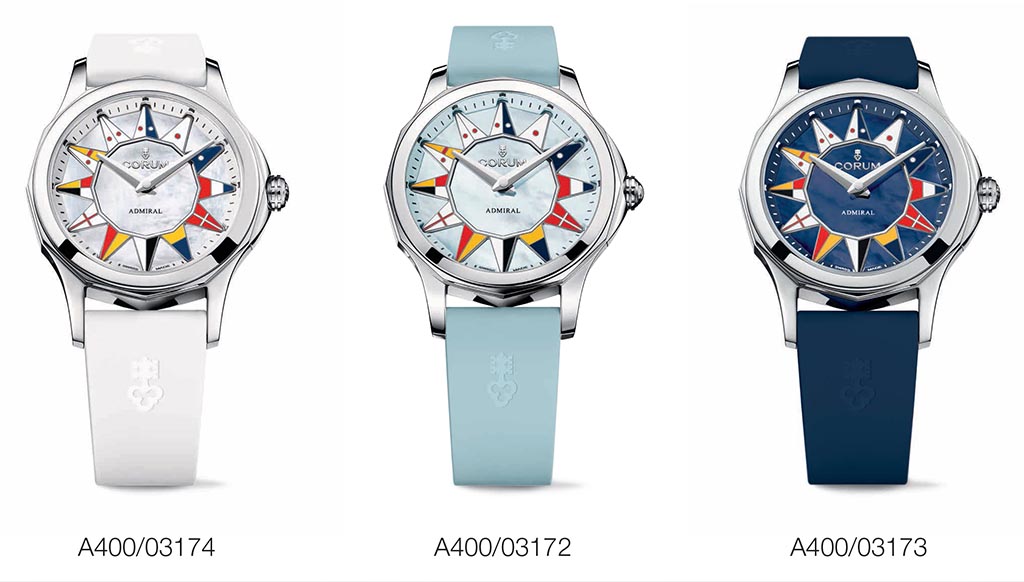
Corum’s emblematic Admiral collection has three new vibrant additions in a range of maritime tones—in 32, 38 and 42 mm proportions. The 42-mm twelve-sided case in steel or steel and rose gold sets a course for elegance, with a blue or white dial on the automatic version, blue or black on the chronograph, and broad luminescent hands sweeping over it. The back of the steel case, which is water-resistant to 50 metres, gives a view of the automatic movement with its engraved rotor. Oscillating at a frequency of 28,800 vibrations per hour, with a power reserve of 42 hours, the functions of the calibre CO 395 comprise hour, minute, small second and date display. The Admiral Legend 42 Chronograph comes with a case in steel or steel and rose gold concealing an automatic movement with hour, minute, small second, chronograph and date displays, and power reserve of 42 hours. The functions of the calibre CO 984, oscillating at 28,800 vibrations per hour, are displayed on a blue or black dial. The feminine versions come in two case widths (32 and 38 mm), curved lines in steel, rose gold or two colours, and an alabaster display with coloured nautical insignia. With an automatic movement bearing the Corum signature, the Admiral Legend Automatic features hour, minute, seconds and date displays on the 38-mm model, and hour and minute display on the smaller model with a mother-of-pearl dial. Both models feature a sapphire crystal case back and are water-resistant to 50 metres.
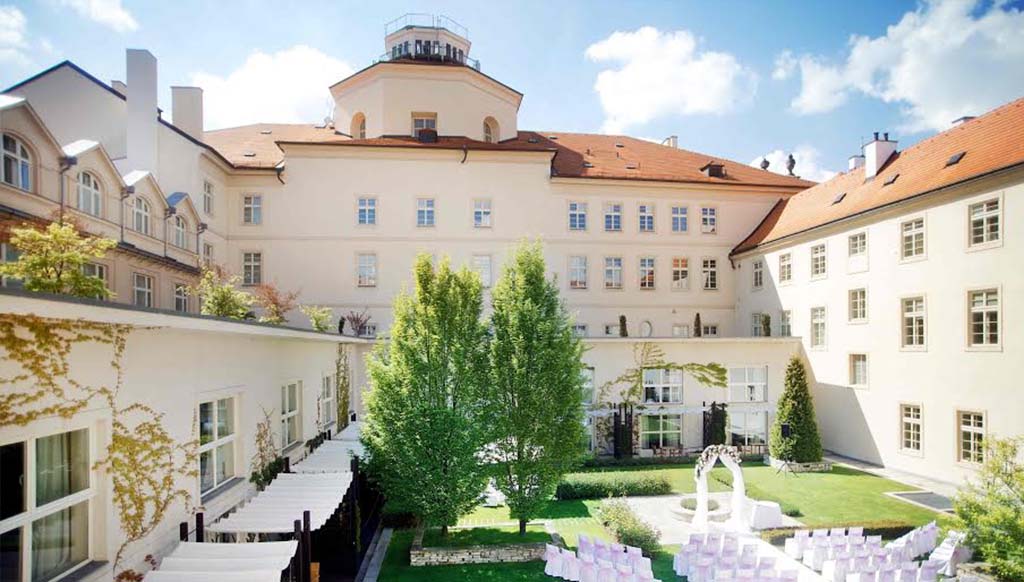
Mandarin Oriental, Prague is offering a fairy-tale wedding package for brides and grooms that’s fit for heads of state. Couples booking the Once Upon A Time package will stay in the Presidential Penthouse Suite, enjoy aromantic wedding ceremony in the hotel’s private Renaissance chapel and indulge in other memorable treats, including a sunsetriver boat cruise. Originally a Baroque-era monastery, Mandarin Oriental, Prague is located in the centre of the city’s romantic and picturesque Lesser Town district, making it the perfect location for a wedding. Couples booking the Once Upon A Time package will be welcomed to the Presidential Penthouse Suite witha bottle of champagne and other indulgences. Also, they will receive an exclusive shopping discount card and map of participating stores, including Tod’s, Versace and Valentino, where private visits can be arranged by the hotel. An early morning check-in will be available for the bride,so she can start her dream day in her wedding boudoir, welcomed with a glass of Prosecco. After the wedding ceremony in the hotel’s historic Renaissance-erachapel,the newlyweds and their families will be treated to a gourmet late lunch on the Presidential Penthouse Suite’s private terrace, which has stunning views over the rooftops of the golden city, including Prague Castle. Following lunch, the couplecan enjoy a private sunset boat tour aboardthe luxuriously equipped Šemík.Sipping champagne and tasting an assortment of delicacies prepared by Executive Chef, Zdeněk Křížek,they can soak up the beauty of Prague, while romantic touches are added to the Presidential Penthouse Suite during the turndown service. Package rates start from EUR 9,350 for a minimum of two nights’ stay.
Italian brand Riva are celebrating their 175th shipbuilding anniversary with the introduction of the Rivale 56 Open Yacht, which boasts of being among the most exclusive open yachts in the world. Powered by twin 1000 HP MAN engines with V-Drive, the yacht boasts a cruising speed of 31 knots and top speed of 35 knots. Large glazed windows containing flush portholes run almost the entire length of the hull while the windshield protecting the pilot is also engineered to aid the aerodynamics of the hull. The stern holds a Williams 325 tender behind a carbon fiber shell. There’s also a roll bar over the deck lounge area that also supports the antennas for the various electronics. A Seakeeper stabilizer can be optionally fitted for roll reduction if the craft is taken into the open seas.