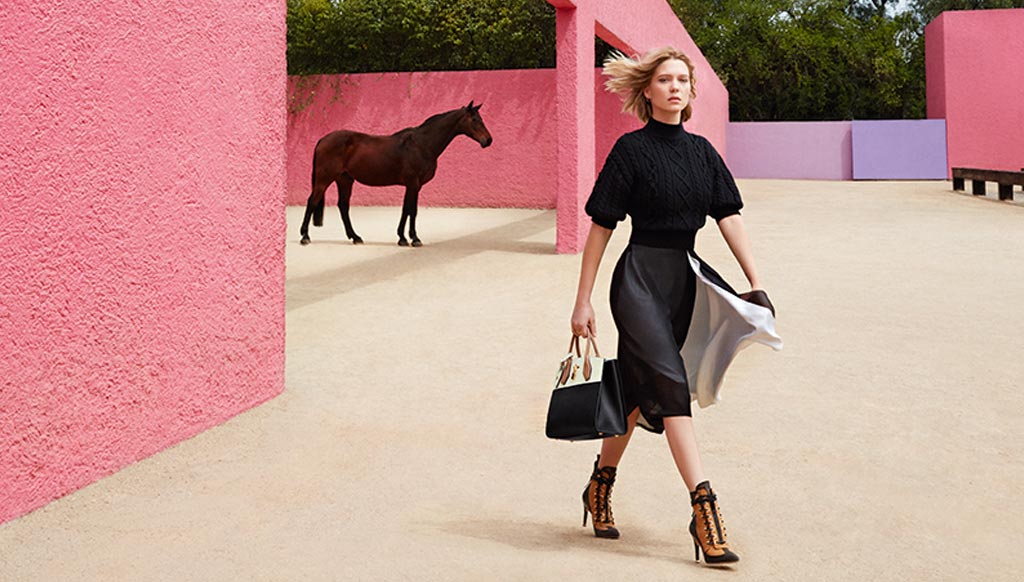
Léa Seydoux goes from Bond Girl to campaign girl for Louis Vuitton’s Spring/Summer 2016 campaign. Decked out in the label’s athletic and cyberpunk pieces, the Spectre actress portrays a “daring, confident heroine who is constantly on the move” within the modernist compounds of Cuadra San Christobal. The “travel” campaign is lensed by the famed Patrick Demarchelier and styled by Marie-Amélie Sauvé. “I deeply admire Nicolas Ghesquière’s work, especially his newness,” Seydoux said earlier this year. “His incessant search for novelty is also highly impressive.”
Combining the thrill of hi-tech aided exploration with an ethical sailing experience, these concepts envision the great things to come
DRAGONSHIP 25
DRAGONSHIP 25 | An ethical sailing experience built for exploring Asia
LOA: 25m
Designer: Pi Super Yachts
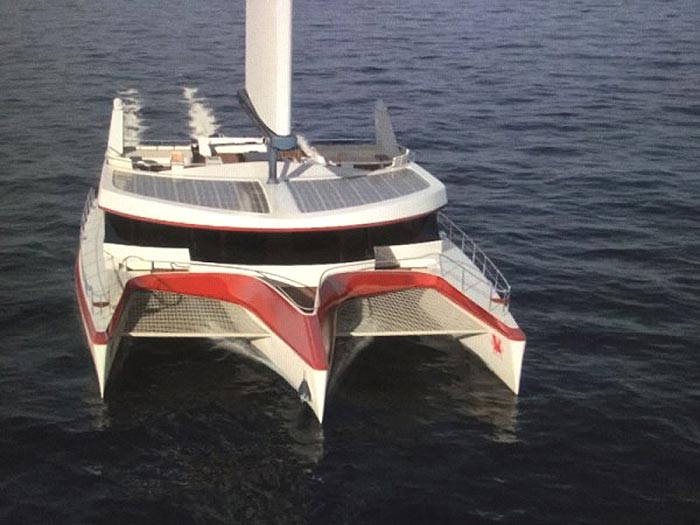
At the centre of Welsh company Pi Super Yachts is a desire to ensure the only thing their trimarans create are memories. Designed to accommodate 10 guests and four crew, the trimaran Dragonship 25 concept is almost ‘carbon free’, meaning that by combining technology powering electric propulsion and solar PV panels on the roof with the Autosail wingsail technology, there are almost no carbon emissions and the yacht is nearly silent when running on full power. A truly ethical sailing experience.
WAVEPIERCER CATAMARAN
WAVEPIERCER | Combining volume and visibility
LOA: 68m
Designer: ThirtyC
Specifically developed for cruising and exploring the Asia Pacific region, this 68m catamaran concept from British design studio ThirtyC combines a great deal of volume with excellent visibility. Designed with a forward touch-and-go helipad and space for a large tender concealed below, this cat will enable her owners to explore closer to shore the unique coves, bays and island anchorages that this region has to offer.
SEAXPLORER
SEAXPLORER | Designed by Amels and Damen to reach the most remote places on earth
LOA: 65m / 90m / 100m
Designer: Azure Yacht Design and Naval Architecture
Builder: Damen
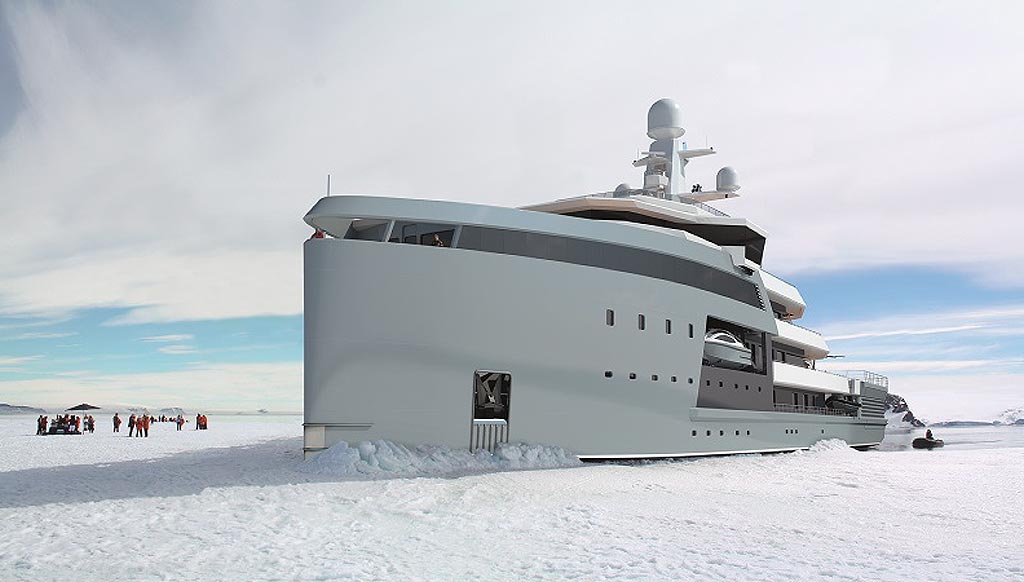
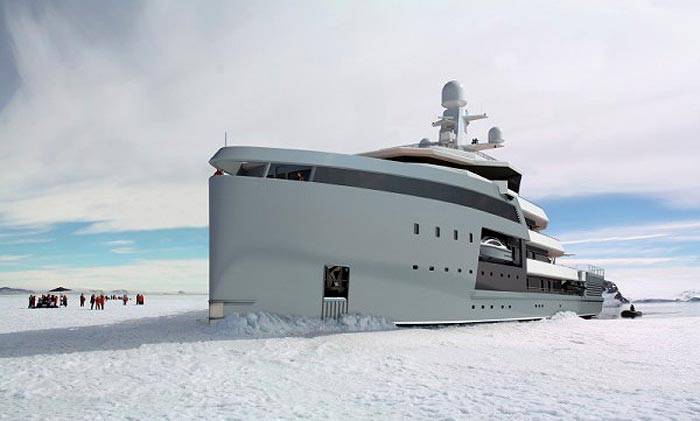
At the Monaco Yacht Show 2015, Amels and Damen revealed plans for the world’s first purpose-built, Polar Code-compliant range of expedition yachts. Available in 65m, 90m or 100m versions, the SeaXplorer is designed to reach the most remote locations on earth. Specialists in planning exclusive trips for high end clients, EYOS Expeditions partnered with the shipyard team to ensure the design is entirely adventure-ready in a way most converted expedition vessels are not.
GDG65
GDG65 | Six deck motor yacht Created by Guide de Groot Design for an Asian client
LOA: 65m
Designer: Guido de Groot Design
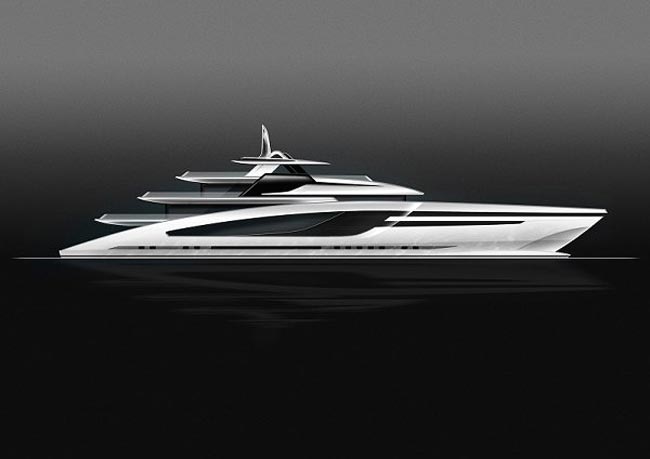
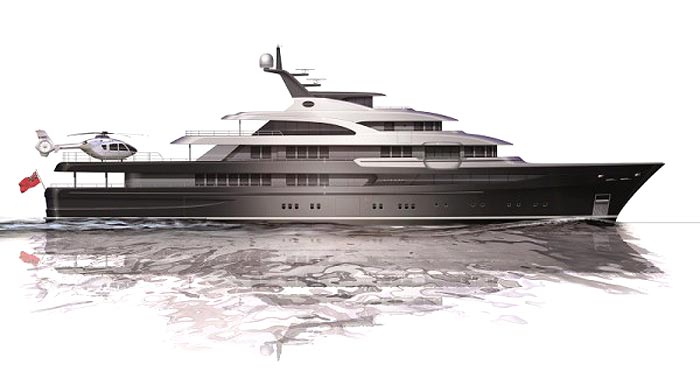
Guido de Groot has exclusively revealed this first image of a 65m, six-deck motor yacht capable of cruising and operating for long periods in both the tropics and arctic regions. Designed for an Asian client, this yacht has been created for living on board for extended periods and as such features a unique owner’s deck with balconies, private external spaces, a private lounge, informal dining area and a large office.
WD100
WD100 | Andrew Winch designed trimaran with a masculine profile
LOA: 100m
Designer: Winch Designs
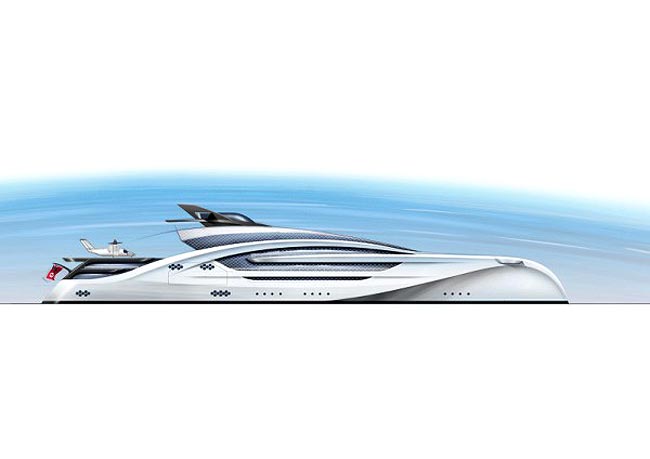
Inspired by clients who want to push the boundaries, Winch Design has created a 100m trimaran with a masculine profile that has space on deck to land an Agusta Westland 609, a kind of tiltrotor aircraft with better range, performance, and payload when compared to a helicopter.
Starting May 19, Sotheby’s will be holding an auction for the sale of iconic fashion photography with work from sought-after names like Richard Avedon, Peter Lindbergh and Guy Bourdin. The sale will coincide with Photo London, a citywide cultural fair that brings together local galleries, auction houses and museums in celebration of the art of photography. The images will range from the early 20th century to the present day, pairing the works of Helmut Newton and Irving Penn with modern images from David La Chapelle and Miles Aldridge. The auction’s two standout pieces include Mouth, photographed for L’Oreal’s 1986 campaign of a model’s lips smudged with varying shades of lipstick, and Peter Lindbergh’s Mathilde, a visual tribute to German fashion photographer Erwin Blumenfeld. This is only the third time Mouth, lensed by Irving Penn, has gone up for auction, and is expected to bring in £180,000 to £230,000 (approx. USD $262,440 to $335,340). Other iconic images include Models, a Lindbergh piece that captures the supermodels of the ‘90s including Christy Turlington and Linda Evangelista playing around on the beach which is estimated to sell for £60,000 to £80,000 (approx. USD $87,447 to $116,612).
Held biennially, the World Design Capital (WDC) is a city promotion project that celebrates the accomplishments in design. As populations grow and economies prosper, the future success in cities are largely reliant on urban planning, design and management. Taipei joined Torino, Seoul, Helsinki, and Cape Town when it was inducted into the league of World Design Capital this year. A global event initiated by the International Council of Societies of Industrial Design (ICSID), WDC is selected every two years among applicants with the most design potential. Taipei, like other cities, is expected to face many social challenges in the future, including population, economy, urban environment, healthcare, ecology, and housing, as it grows and matures. In 2012, the city government began initiating several projects under Public Policy by Design. Taipei was the first city in Taiwan to adopt design as a means of urban transformation. Through cross-departmental integration of the city government and participation of experts from industry, government, academia, design professionals, and citizens, the Taipei City government reviews urban problems and uses design thinking to develop public policy based on people’s needs. In addition, Taipei was the first city in Taiwan to hold a series of courses on design thinking in order to cultivate public servants’ knowledge of the concept of design thinking to permeate into all government agencies. Based on the spirit of ‘adaptive city’, WDC Taipei 2016 hopes to call on local designers and citizens to promote urban innovation in Taipei through co-design. Through Adaptive City – Design In Motion, WDC Taipei 2016 will demonstrate that Taipei is an adaptive city that continues to improve, and strives to solve social problems through social design.
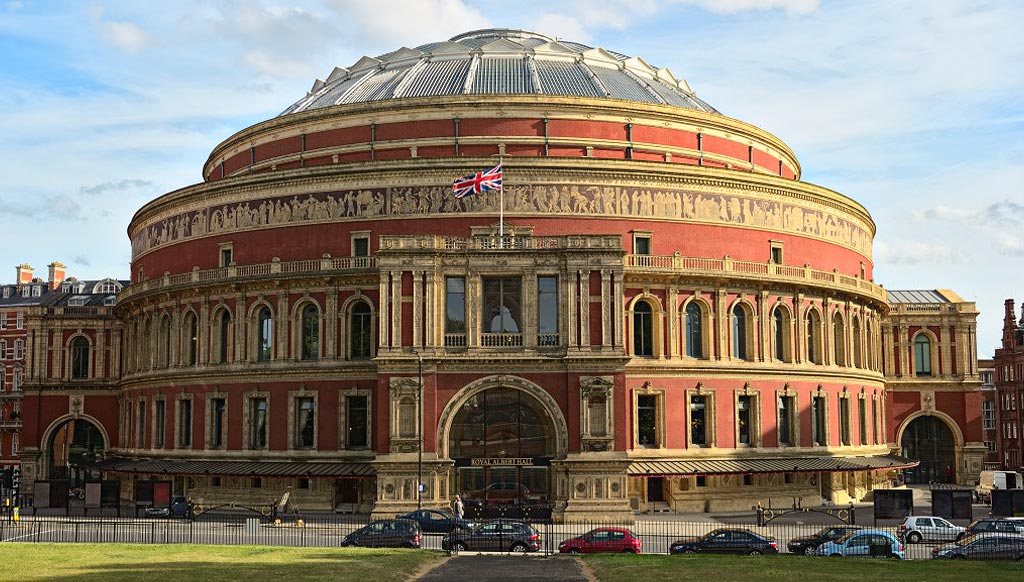
The British Fashion Council (BFC) is set to undergo a high-gloss makeover this year to establish a more global audience. Formerly dubbed British Fashion Awards, The Fashion Awards this year is a collaborative effort with Swarovski and takes place on December 5, this year at the Royal Albert Hall in London. Besides honoring British talent, international talent from both the creative and business sides of the industry will also be nominated for awards. Switching to the famed Royal Albert Hall means that the ceremony can now seat up to 3,000 people (1,000 more than The London Coliseum), thereby garnering higher ticket sales and also international television partners. Half of these seats will be available for purchase by the general public, making it a fantastic opportunity for fashion enthusiasts to also be part of this annual extravaganza. However, BFC’s ultimate aim is to raise significant funds over the next 10 years to provide scholarships through the Education Foundation, which offers financial aid to those attending top fashion colleges. Speaking to Business of Fashion, Dame Natalie Massenet, chairman of the BFC, said the organization hopes to create an event which aspires to be “a mix of the Academy Awards and the Met Ball, on a global scale”.
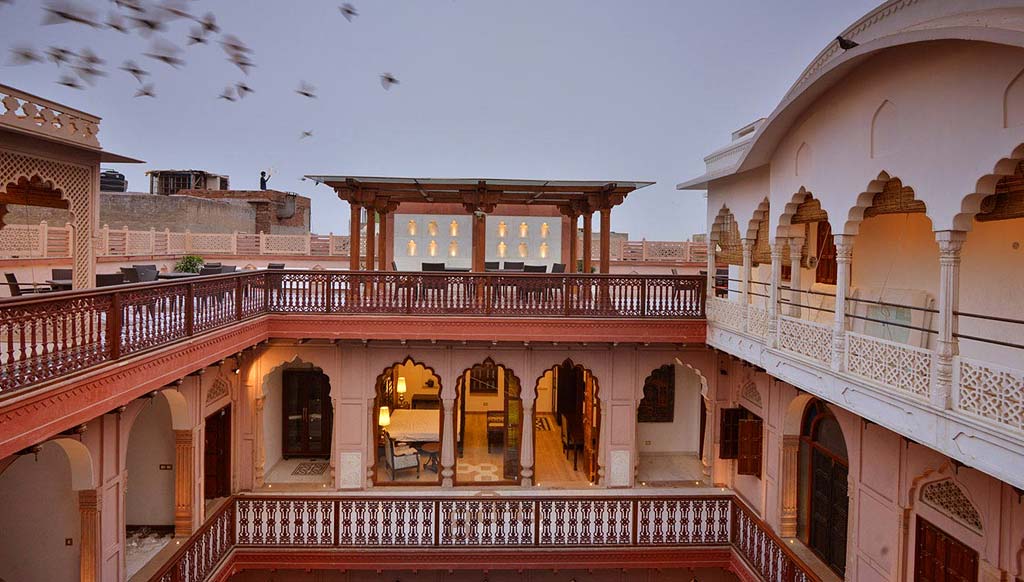
PAEAN TO THE PAST | Haveli Dharampura is a revivalist’s dream which stands silent and elegant, in all its restored glory, amidst the curious cacophony of Chandni Chowk
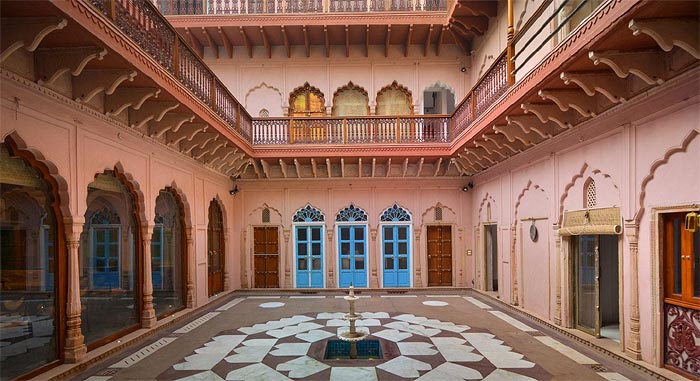
The bylanes of an old city, steeped in mystique and flaunting a motley mix of markers that speak of the good old times, are in stark relief to all the efficiently constructed cacophony of the city as lives outside the worn peripheries of its walled-in prototype. Looking through this enigmatic time warp, one glimpses, at times, visions of the glory and grandeur which then permeated its fabric and which now stands to purport the old world charm of Delhi 6. One such vision is the painstakingly restored Haveli Dharampura which sings of a late Mughal style with its jharokas and stained glass windows, balconies, multifoliated arched gateways, carved sandstone façade, and intricately tiled floors and fountain in the central courtyard. Dating back to sometime in 1887, this is one property which has been restored, over a period of 6 years with the help of Heritage India foundation and with the passionate involvement of former Rajya Sabha MP Vijay Goel. While Chandni Chowk has always been about street food and getting positively delicious greasy fare at a Karim’s or Al Jawahar, it is also about getting lost among its numerous and narrow bylanes. But Haveli Dharampura stands tall, located at a two-minute walk from Jama Masjid Police station towards Gali Guliyan, and from its wide and beautifully reconstructed terrace offers a panoramic view of Old Delhi’s monumental stalwarts, from the Jama Masjid, Red Fort, Gurudwara Sis Ganj Sahib, Gauri Shankar Temple to St James Church.
TUCKED-IN TREASURE | Promising a walk down a vintage memory lane, there is a 5’ alley with residences and small shops on both sides that lead you to the Haveli
The stories and the sceneries in and around the Haveli have actually come to life with this revival and in an interview earlier this year, Mr Vijay Goel has elaborated, “While restoring this Haveli, top priority was given to retaining the original character and maintenance of the same. All conservation work followed basic principles such as minimum intervention in the historic fabric and respect for historic evidences adopted in various international charters for the conservation of heritage sites.” Calling to all the culture and art connoisseurs, the Haveli is a treat for the eyes with a marvelous coming together of disparate ethnic elements like the cast iron railings from Jaipur which speak of Shahjahani design, the entrance wooden door carved in Shekhawati style, the Moradabadi brasswork and glasswork from Ferozabad.
OLD NOTES, NEW SONGS | Spacious accommodations, splendid restaurant, and warm hospitality await you at the Haveli which is a doorway into an exclusive culture
An expansive mansion with its three floors housing 60 rooms in the earlier times, there are now 13 stately rooms, [3 Jharokha Rooms, 4 Diwan-e-Khas Rooms, 6 Shahjahan Suites], done up in a traditional style with antique or art-deco furniture, beautiful ceilings and windows opening out into a balcony, alcove or a siting area. Celebrating the old and the new alike, there is emphasis on staying true to its origins even as the doors are named after the famous entryways of yore – Kashmiri, Turkmani, Ajmeri and more. Mixing up the residential and the commercial, the Haveli also boasts of many splendid engagement options – a spa, two restaurants (of which the Indian one, Lakhori, is currently functional), a small art gallery and in future might be just be the ultimate space for revival of artistic pursuits which are so much a part of Old Delhi’s rich heritage.
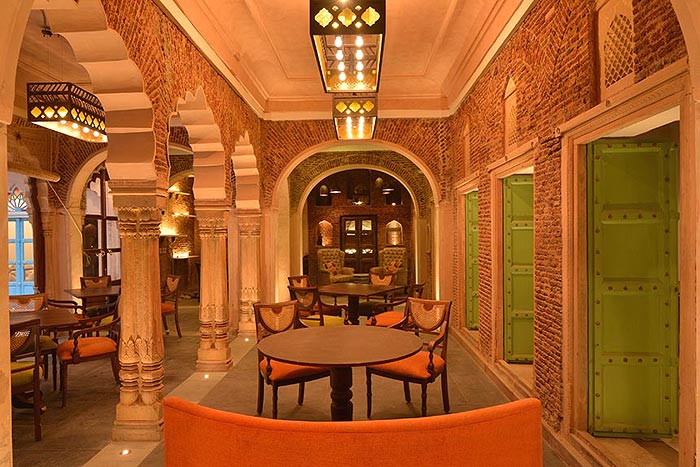
A MENU TO MASTER | The restaurant, Lakhori, combines artful presentation with tasteful Indian flavours as its celebrates Purani Dilli ka khaana
Speaking of heritage, there is no taking away the cuisine from the culture and the Haveli has just the perfect setting for one’s gastronomic indulgences from a menu which has been carefully crafted as a modern tribute to the Mughal-inspired north Indian food universe. Lakhori, as this restaurant on the ground floor of the Haveli is called, refers to the kiln-baked lakhori bricks used during Mughal times and sports an old-world ethnic ambience which does justice to the food-based reputation of the place of its origin – Chandni Chowk. With the fine dining aspect in place here, it’s a welcome change and a bit of an adventure in itself to not be eating ‘dirty’ items like papdi chaat, dahi puri, and palak patta chaat. Not to disappoint the meat lovers, Lakhori serves the much-sought after classics such as mutton korma and kadhai chicken [served in a roti bowl and finger licking good]. For those who prefer their plants, there is a deconstructed aloo gobhi mutter [that any self-respecting north Indian restaurant will serve and which their chef has brilliantly re-interpreted] and kofta dogala [spinach wrapped cottage-cheese with a tomato and malai gravy]. With all of this in place, Haveli Dharampura sure is one haven of heritage pleasures and sensuous delights.
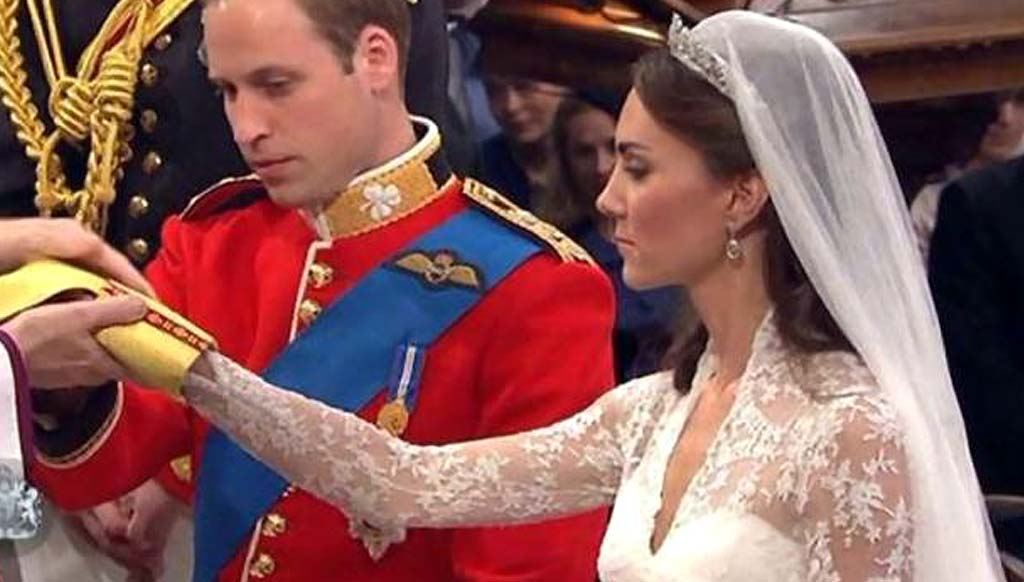
Alexander McQueen is being sued. A Hertfordshire-based designer has alleged that the British luxury fashion house ripped off its designs of Kate Middleton’s royal wedding dress, and has filed a claim at the Intellectual Property Enterprise Court in London. According to wedding dress designer Christine Kendall, who runs a studio in Hertfordshire, Kate’s bespoke lace wedding dress from her royal wedding in 2011 is a dead ringer for Kendall’s own sketches, which she reportedly presented to the Duchess of Cambridge as an idea for the royal gown. The Duchess’ $58,000 embroidered gown was created by Alexander McQueen’s creative director, Sarah Burton, and hand-stitched at the McQueen studio. “I believe without my sketches the royal wedding dress would not have looked as it did,” Kendall said in a 2013 YouTube video. Kendall’s allegations appear to be only directed towards Alexander McQueen, however. According to a statement by Kendall’s solicitor to the International Business Times, there are no allegations made against the duchess or the palace. Both the Duchess and Alexander McQueen are reportedly baffled by the lawsuit, with spokespersons for both parties confirming that neither has ever seen Kendall’s sketches in the first place. The Duchess of Cambridge is known for her fondness of Alexander McQueen’s designs, such as the red peplum skirt she wore during her Royal India tour.
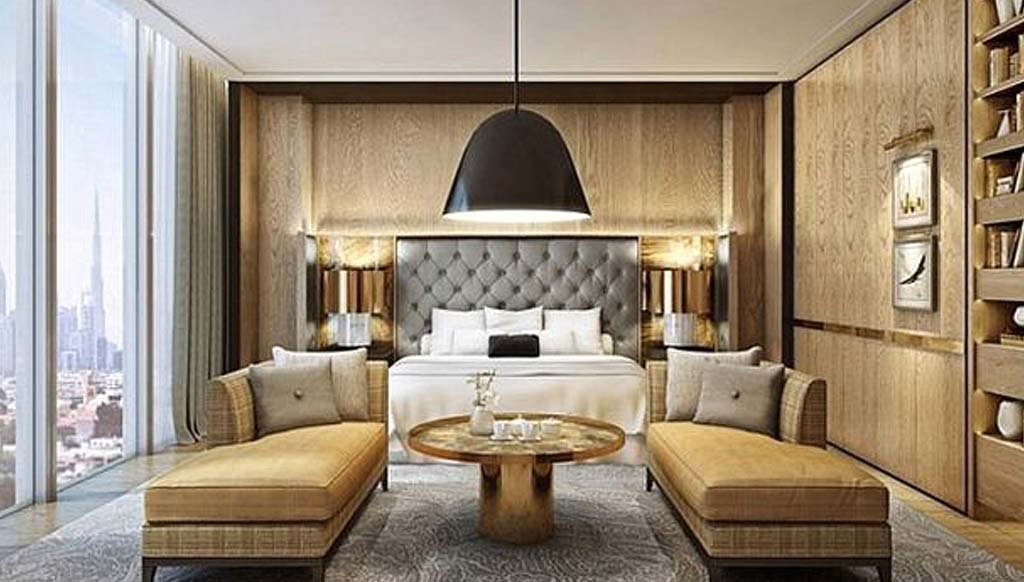
Hilton Worldwide this week announced it will open a Waldorf Astoria Hotels & Resorts property in Dubai International Financial Centre (DIFC). With the hotel expected to begin welcoming guests in the Autumn 2017 joining the portfolio of 25 Waldorf Astoria properties operating around the world. “Sound fundamentals underpin our luxury story in the Middle East, where we have seen exceptional growth in locations tailored for both leisure and business travellers,” said Carlos Khneisser, vice president of development, Middle East and North Africa for Hilton Worldwide. “I have long admired the role DIFC plays in the world of international investment, benefitting from its east meets west location and world-class trading framework. As an iconic luxury brand originating from New York, another centre of global finance, I am delighted that we will welcome Waldorf Astoria to this international hub.” The hotel will feature 247 guest rooms as well as a range of dining options, spa and wellness facility.
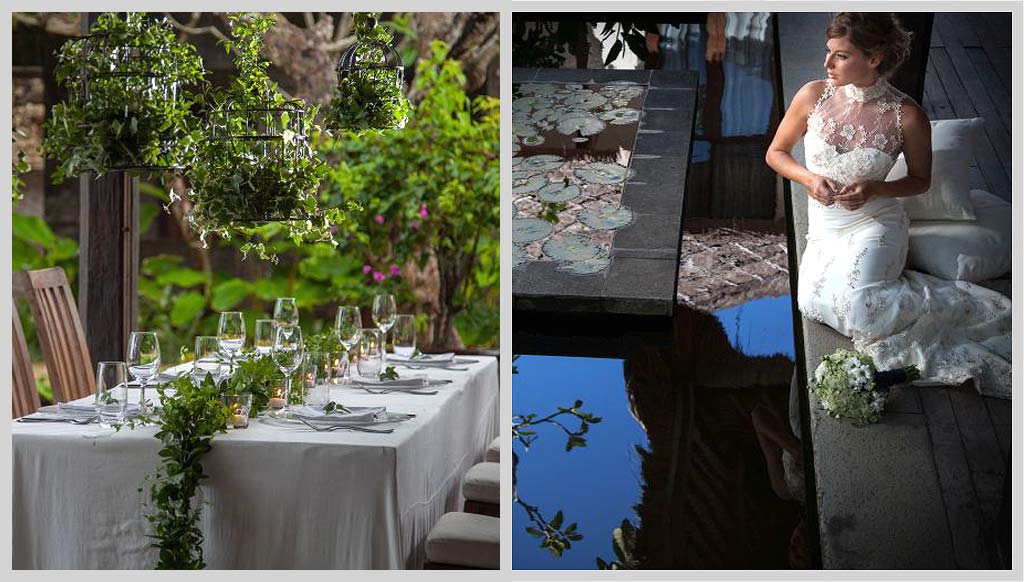
One of the most sought after wedding specialists in Bali, Tirtha Bridal, will be unveiling The Glass House this summer in a new wedding venue designed to fulfil your dreamiest fairytale fantasies. Imagine exchanging vows in an enchanted garden, basking in the warm glow of sunset, under the soft illumination of stars. By summer, this will no longer be a concept but a reality you can have. In a stunning collaboration with renowned architect Fredo Taffin and the award-winning landscape design studio Salad Dressing, Tirtha Bridal will soon launch the ethereal bridal concept into something of a reality. Among Taffin’s greatest work is the legendary Ku De Ta and The Istana, both acclaimed destinations. Tirtha Bridal was first established in 1998 by Japanese husband-and-wife duo Koji & Yuka Koreyasu, who desired to bring unique and incomparable weddings to the gorgeous backdrop of Bali. The name was inspired by the Balinese word for ‘Holy Water’. Designed to transport you and your guests into another world, The Glass House by Tirtha Bridal will officially launch in the third quarter of 2016 in Uluwatu, Bali.
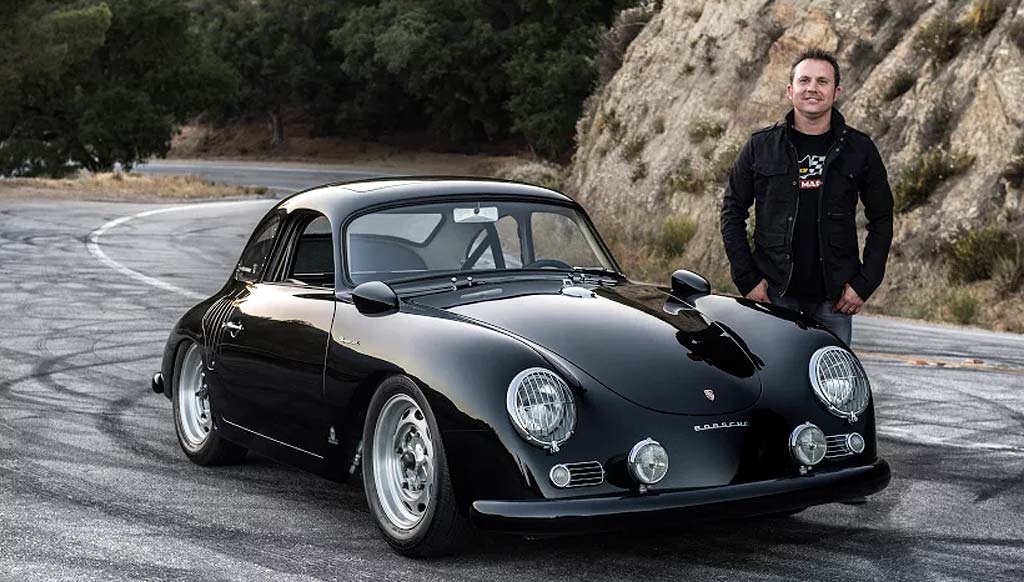
THE MASTER AND THE MUSE | Rod Emory likes to build cars that don’t just go fast, but also look fast standing still (Photo: Drew Phillips/Courtesy: Emory Motorsports)
In the world of customised sports cars, Emory Motorsports spells thrill and luxury like no other. If a Porsche 356 has been touched by an Emory, it’s been transformed into an Outlaw or a Special, a legendary creature of dramatic performance and unique elegance — all vintage-class. Purists might sometimes turn up their noses at what is for them a heresy, but the desirability quotient of these cars is nothing short of phenomenal. We bring you an exclusive tete-a-tete with the man himself — Rod Emory, founder and creator, who’s been building cars since the age of 14 — and for whom Porsche runs in the blood.
The Luxe Cafe: Tell us about the origin and evolution of Emory Motorsports? Growing up in Trabuco Canyon, CA, life was about competition. Since before I can remember, I’ve been racing something. To be the fastest at anything was the goal, whether it was bicycles or ATV’s or cars. My mechanical upbringing laid the foundation for everything that I am today. My grandfather Neil Emory co-founded a car customising business known as Valley Custom Shop in Burbank, CA. The basis of his life’s work revolved around the idea that the cars the major American manufacturers made were good, but that he could restyle them aesthetically to make them great. It’s not that his idea was original, many others were doing similar things; it’s that his designs and his eye for proportion were exceptional. Today his cars are highly prized possessions, fetching substantial sums at auction when they do occasionally cross the block.
Our cars were relegated to the spectator parking lot and our friends jokingly referred to us as the “outlaws” because we did not conform
My father Gary also had the design gene and kept the family firmly rooted in Porsche with a business called Parts Obsolete, a retail enterprise which benefitted from Porsche’s factory parts obsolescence. Blessed with the know-how of auto body repair and modification, assisted with the availability of factory parts, I built my first Porsche when I was just 14 years old. This 1953 split-window coupe is a car I raced in “vintage” classes for almost two decades.
SPEED DEMON | Each of these cars gets a ground-up, bare-metal rotisserie restoration (Photo: Drew Philips/Courtesy: Emory Motorsports)
Along the way, my father and I built many more street cars for customers, all variations of the Porsche 356 and early 911, but always using a race- or rally-inspired design aesthetic. Let’s face it, there’s nothing sexier than race cars, because they benefit from the kind of aerodynamic touches and weight reduction techniques that my grandfather had been applying to cars through the decades. The street cars we built looked different because we wanted them to go fast, but also to look fast standing still.
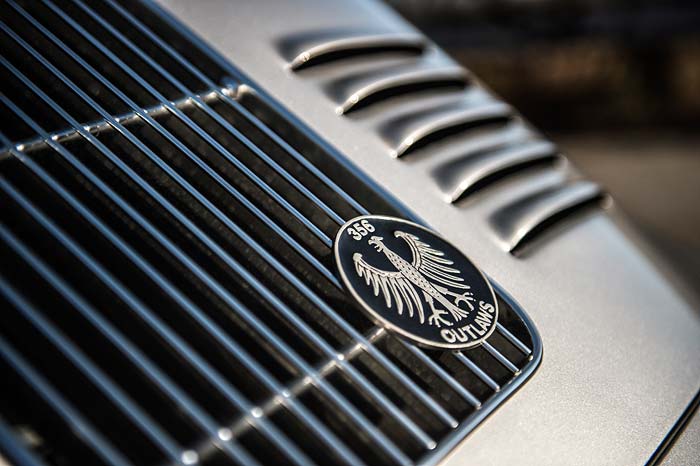
How did you begin using the term ‘Outlaws’? In an era when the dyed-in-the-wool Porsche community actively sought to restore decaying cars to factory specification, our cars, even though our restorations were every bit as good, were excluded from awards consideration at judged concours. Our cars were relegated to the spectator parking lot and our friends jokingly referred to us as the “outlaws” because we did not conform to the then accepted norm within the Porsche hobby. In the late ’80’s, a jeweler friend of ours crafted a grill badge using a stylized heraldic eagle and the words “356 Outlaws.” Since then we have used this badge to not only distinguish the cars that we build, but also to recognize the efforts of individuals whose 356 modifications satisfy my idea of what an “Outlaw” should be.
My parents brought me home from the hospital after I was born in a fat-fendered Porsche 911
My wife Amy and I created Emory Motorsports to fulfill a need we saw in the marketplace. Wherever I raced my blue ’53, people would say to me “I’d like to go racing. How do I do that?” With many types of competition experience and with a ready supply of resources, I was able to build dozens of vintage-class race cars and act as a driving coach for the people who owned and drove them. Our customers competed in events from Seattle to Daytona. While we were racing, we continued to build Outlaws and Specials, street cars which now number more than 150.
BADGE OF HONOUR | The ‘356 Outlaws’ badge represents not just the cars he builds, but cars that satisfy Emory’s idea of an Outlaw (Photo: Drew Philips/Courtesy: Emory Motorsports)
Why just Porsche? Why not others? My parents brought me home from the hospital after I was born in a fat-fendered Porsche 911, so the Porsche marque has been imprinted on my DNA from day one. When you study the subject of Porsche you realize that the encyclopedia of information just relating to their competition experience is enormous. There simply isn’t enough time for me to be as expert as I am with Porsche for any other marque. You know best what you grew up with and I feel like I have been inside Ferry Porsche’s head since the beginning. Also, the early Porsche passenger cars lend themselves quite nicely to tasteful modification. The advancement of engine, suspension and braking technology has made the job of customising the 356 more exciting than ever.
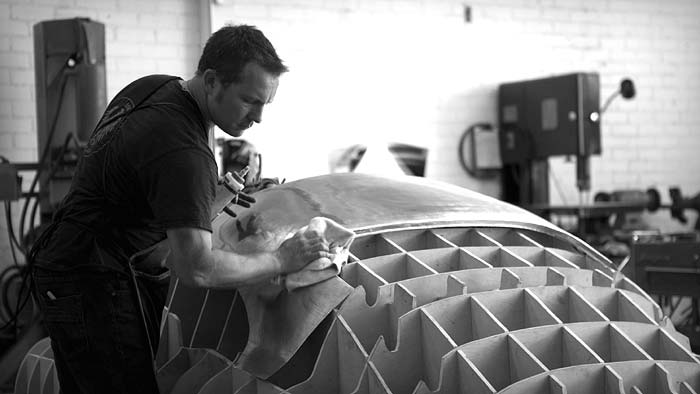
Tell us about your work, the kind of alterations and customisations you work upon the Porsches. Each Emory Outlaw or Special is a bespoke automobile tailored to its customer’s wishes and each one began life in Porsche’s factory in Germany. Each car benefits from a ground-up, bare-metal rotisserie restoration where we repair damage from corrosion & accidents, strengthening the unibody chassis in the process.
For an Emory Special we restyle the exterior design aesthetic in a way we think that Porsche themselves would have done if they had had the luxury of time
An Emory Outlaw is a Porsche 356 that maintains its original design, but from which we have removed or streamlined the bumpers, added our signature louvers to the engine lid, built higher-horsepower engine, added more modern Porsche suspension and drivetrain and customised the interior with understated upholstery and functional technological enhancements.
SOUPED-UP SPECIAL | An Emory Special treatment like the one on this car can add $300,000-400,000 additional to the cost of the donor carTHE OUTLAW | Maintains original design, but features streamlined bumpers, signature louvers, customised interiors and higher horsepower engines (Photo: Drew Philips)
An Emory Special takes the idea of bespoke to another level because we restyle the exterior design aesthetic in a way we think that Porsche themselves would have done if they had had the luxury of time. These modification are generally subtle, sometimes undetectable to the untrained eye, but they also take a long time to achieve because we modify the steel skin of the car. But for those who know what to look for, these changes are appreciated because they distinguish the car forever and there will never be another one like it. To date, we have built six Specials. These cars feature unique mechanical appointments that also distinguish them from any other.
Can you describe some of the finest specimens of the Outlaws and Specials you’ve created? The standard bearers of the two classes of cars we build are both based on the 356 A model.
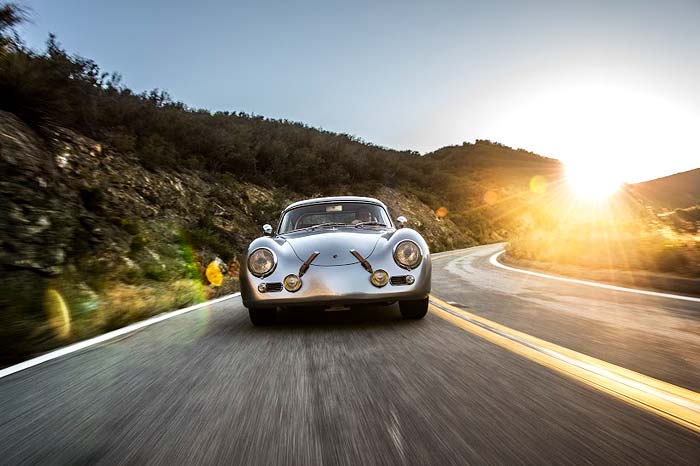
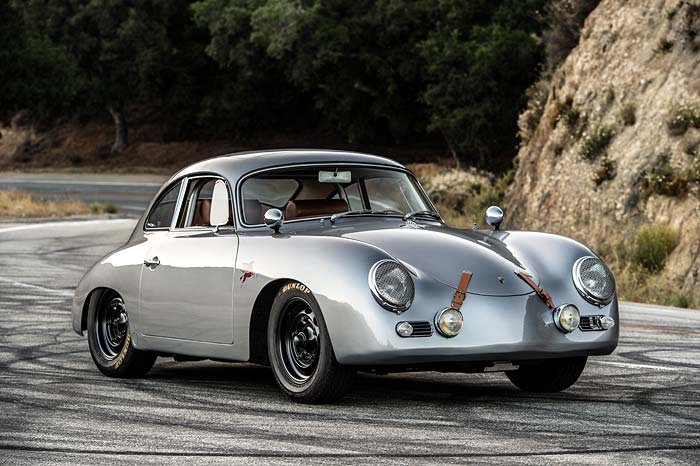
STREAK OF LIGHTNING | The 1959 sunroof coupe with leather hood straps, engine lid louvers, headlight grills and painted Pegasus (Photo: Drew Philips)
This 1959 silver sunroof coupe is an excellent illustration of the Outlaw concept. It has a bumper-less body whose modifications include a shaved hood handle and leather hood straps, body-mounted driving lights, headlight grills, through-hood fuel filler, engine lid louvers, powder-coated aluminum billet wheels, painted pegasus graphic and custom wing windows.
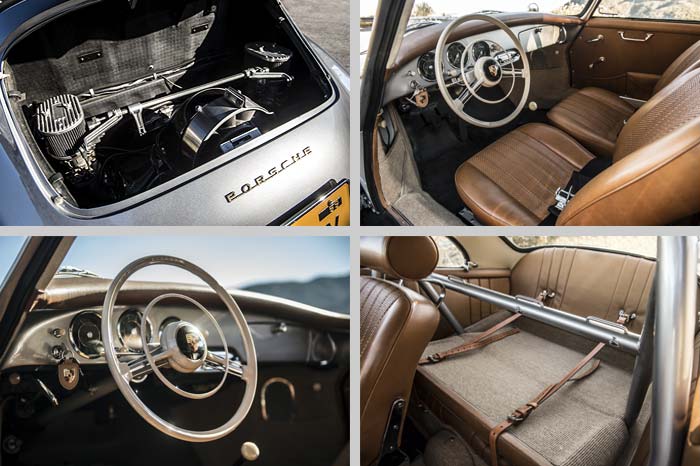
INNER BEAUTY | Baseball-glove-quality leather upholstery, roll cage welded to frame and 2.6-liter 4-cylinder powerplant engine to generate 3 times more horsepower (Photo: Drew Philips)
The interior features a one-off use of baseball-glove-quality leather upholstery including the headrests, with square-woven leather seat panels. There is also a roll cage welded to the frame of the car which creates additional torsional rigidity. The engine is a 2.6-liter 4-cylinder Porsche powerplant made by Fat Performance which generates 180 horsepower, three times the amount the car would have had from the factory. The car has custom disc brakes to make sure it stops as well as it accelerates.
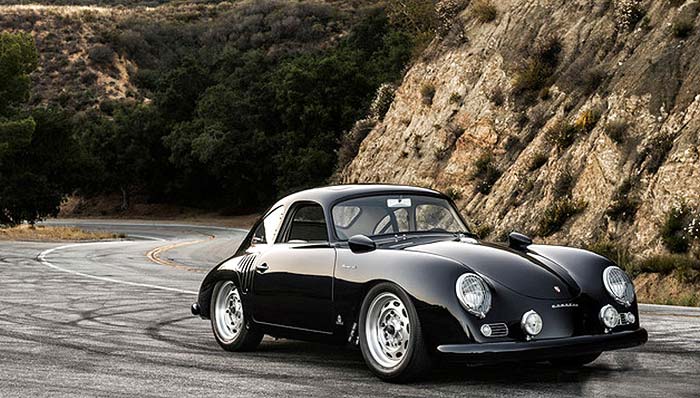
THE DARK LORD | The 1958 A Special with a unique 911-4 engine at its mechanical core, producing 185 horsepower
This 1958 sunroof coupe is representative of the Emory Special line. We built this car for a man who has the newest examples of Porsche technology, including a GT2 and a GT3 RS. He wanted a similar driving experience, but in a vintage package. This car has so many unique features, it’s tough to describe in a short Q & A, but your feature article from earlier this year does a good job of highlighting the most notable items.(http://www.theluxecafe.com/motoring/luxury-cars-superbikes/the-emory-touch-1958-porsche-356-special/ )
Even Jay Leno, whose car collection is extensive, was a little star struck by this car
At the mechanical core of each Special, however, is a unique powerplant known as a “911-4.” This engine design is based around a Porsche 3.6-litre 6-cylinder architecture, but whose center cylinders have been removed to save weight and space. The 911-4 produces a unique sound unlike any other Porsche and accelerates an Emory Special very quickly due to its minimum 185 horsepower and increased torque. Each Special begins with a dream about what could be and is inspired by a few simple ideas, but the combination of which produces a totally engaging driving experience. Even Jay Leno, whose car collection is extensive, was a little star struck by the performance and beauty of this car.
How much do your prized creations sell for? The price for an Outlaw treatment of this caliber—like the one done on the 1959 sunroof coupe—is approximately 225,000 USD additional to the cost of the “donor” car. An Emory Special treatment on the other hand (such as the 1958 sunroof coupe) can add 300,000-400,000 USD additional to the cost of the donor car.
Within each of the cars I build is a little bit of my grandfather
For you, what’s the best part of creating these customised Porsches? For me, it is two-fold. Within each of the cars I build is a little bit of my grandfather, who passed his metalworking and design skills down to me at an early age. Because we are a small family-owned company, several members of the extended family touch these cars at various stages of their rebirth as an Outlaw or Special. These cars are personal.
LABOUR OF LOVE | The cars are personal, says Rod, because several members of the extended family work upon them at various stages (Photo: Ty Milford/Courtesy: Emory Motorsports)
Also, I get immense satisfaction when I see the smile on the owners’ faces when they are driving or just talking about their cars. I build a car that satisfies me but that also resonates with the particular tastes of the owners who now care for them.
What are you working upon at the moment? What more would you like to try out in future? We have a number of very exciting projects in the works. Currently in restoration is a 1951 Porsche 356 Gmund SL which is Porsche’s very first Le Mans 24 Hours works entry and class winner. We are developing the first all-wheel drive 356 as well as a radical makeover of a 356 bodied car based on a ‘70s-era RSR race car. We also have a bevy of Outlaws and a few Specials in progress which will be revealed in the months ahead.